Spec Campaign
LONE STAR BEER — "THEIR WORDS"
Overview
THE ONLY BEER THAT GETS ENDORSED BY THE BARS THAT SHOULDN'T CARRY IT
Craft beer culture spent a decade building a wall between itself and mass-market beer. Chalkboards went up. Policies were written. "No Crap On Tap" became a badge of honor for bars serious about what they poured.
Lone Star Beer is still on those taps.
The Reframe
This campaign doesn't argue that Lone Star is craft. It doesn't argue that craft snobbery is wrong. It lets the craft bar's own policy — printed on the Lone Star tap handle by the bar itself — make the case that no advertising budget ever could.
The beer that was supposed to be excluded became the exception that defined the rule.
The Brief
THE BEER THAT OUTLASTED THE ARGUMENT
Lone Star Beer has been a Texas institution for over a century. It has survived every trend, every craft beer revolution, every "No Crap On Tap" chalkboard that went up in every serious bar in Austin, Houston, and Dallas.
The brief wasn't how to compete with craft beer. It wasn't how to defend Lone Star's place in the market. It was simpler and stranger than either of those.
The Assignment
A craft bar in Austin — the kind of bar with twelve serious tap handles and a written policy against mass-market beer — kept Lone Star on tap anyway. And when asked why, the answer was immediate.
"It's not crap. It's just Lone Star."
That's not a brief. That's a campaign.
The Insight
THE ENDORSEMENT YOU CAN'T BUY IS THE ONE WORTH HAVING
Every beer brand can buy a celebrity. Every beer brand can sponsor a stadium. Every beer brand can run a Super Bowl spot about friends and good times and the perfect pour.
No beer brand can manufacture the moment when the bar that built its identity around excluding you decides to keep you anyway.
Why It Lands
The strategic insight: Lone Star doesn't need to defend itself against craft beer culture. Craft beer culture already defended Lone Star — by making an exception for it. The campaign's entire job is to point at that exception and get out of the way.
The craft bar's "No Crap On Tap" policy on the Lone Star tap handle isn't irony. It's the highest possible endorsement from the most credible possible source — the people who care most about what goes on their taps, and chose Lone Star anyway.
The Concept
NO DIALOGUE. ONE SHOT. THEIR WORDS.
A single unbroken POV shot. No voiceover. No music swell. No bartender to camera. Just the experience of walking into a serious craft bar and finding Lone Star at the end of the tap line — with the bar's own policy printed on the handle.
The Structure
The spot is structured as a discovery. The viewer doesn't know where they're going until they get there. By the time the camera finds the Lone Star handle the audience has already done the work — they've scanned every craft tap, registered the seriousness of the bar, and built the context that makes the punchline land.
Lone Star says nothing. The bar says everything.
THE SPOT — "THEIR WORDS" · :30 SECONDS ↗ READ SCRIPT
↑ Click here to read the entire spec script
The Shot Breakdown
FIVE SHOTS — "THEIR WORDS"
:30 seconds. No dialogue. Single POV. The camera is the viewer. The bar is the argument. The sticker is the punchline.
The Arc
Establish the world → move through it → scan the taps → find Lone Star → let it register. Five beats. No commentary needed.
Shot 01
:00 — :05
The Entrance
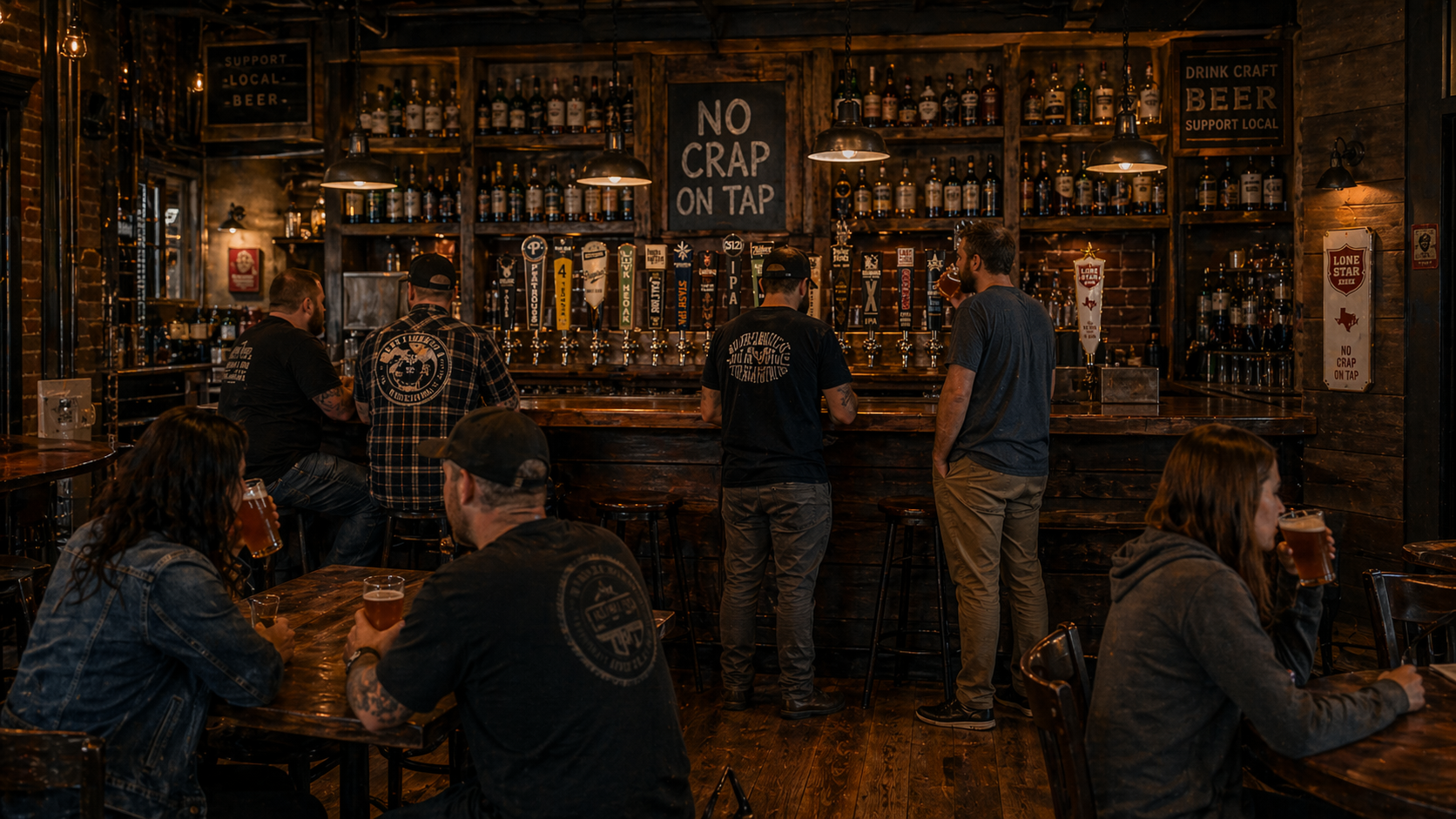
POV enters the bar through the front door. The bar is moderately crowded — not packed, not empty. People at tables and at the bar, drinking from pint glasses. Ambient bar noise. The lighting is warm. This is a serious bar that people actually go to. The camera pauses at the entrance — a natural beat of taking in the room before moving through it.
Establish: this is a real bar. These are real people. This is not a Lone Star bar.
Shot 02
:05 — :12
The Approach
POV moves through the bar toward the taps. Natural movement — around a stool, past a table, the slight adjustment of navigating a crowded space. The taps become visible ahead. The camera is headed somewhere specific but hasn't revealed it yet.
Build: the viewer is moving toward something. The destination matters.
Shot 03
:12 — :22
The Scan
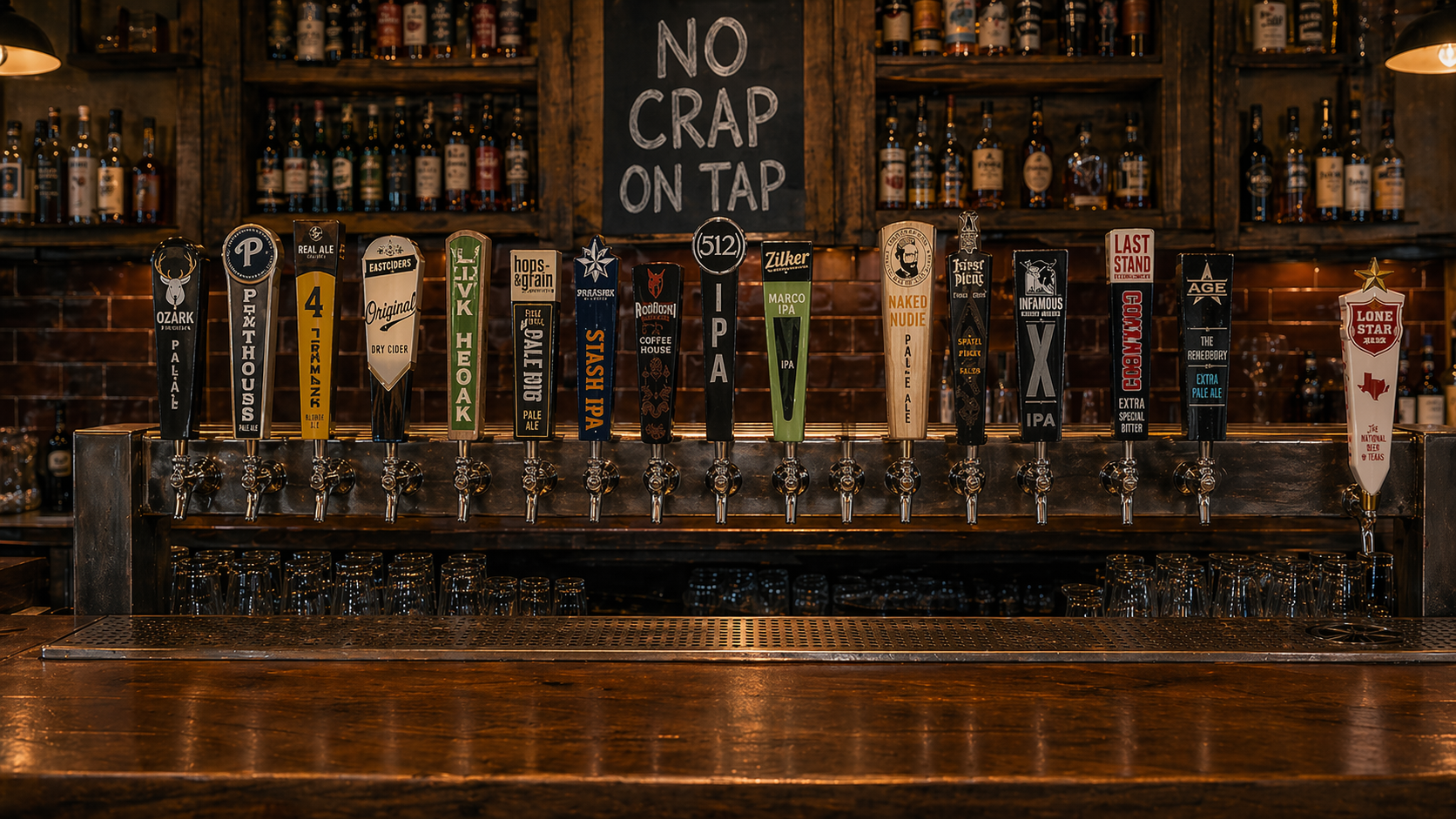
POV reaches the bar. The camera begins a slow scan left to right across the tap handles. Every handle is a craft beer — local breweries, regional favorites, serious labels. The scan is deliberate. Unhurried. The viewer reads each handle. The bar means what it says about what it pours.
At the far right of the tap line, slightly separated from the others — a gap, a small visual pause — the Lone Star handle comes into frame. The separation matters. It's not hidden. It's not ashamed. It's just apart.
Shot 04
:22 — :27
The Handle
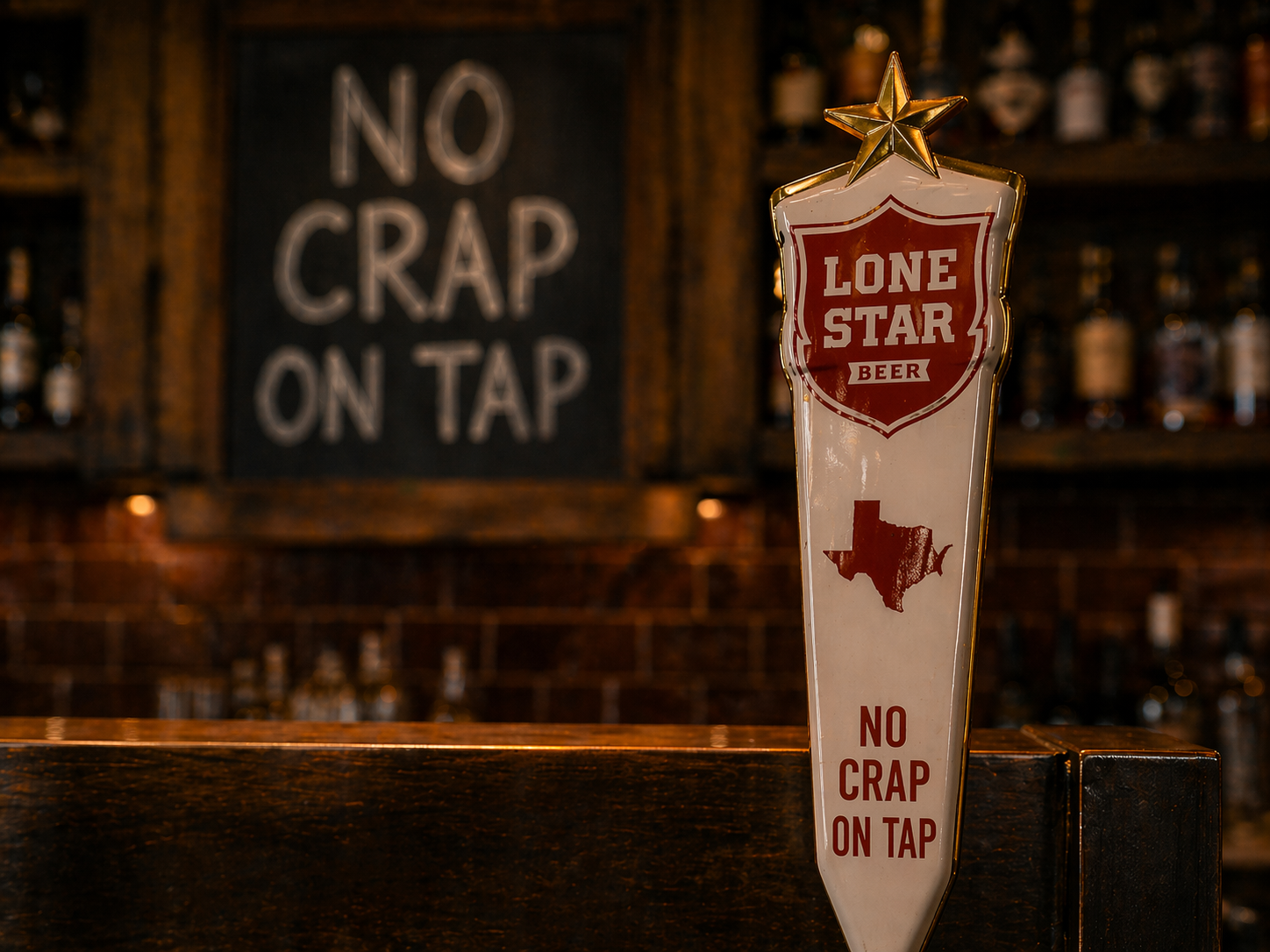
The camera pushes in slowly on the Lone Star tap handle. The iconic label. The Texas star. And at the bottom of the handle — a sticker placed there by the bar itself:
NO CRAP ON TAP
Hold on it. Let it register. Don't rush it. This is the entire campaign in one image.
Shot 05
:27 — :30
The Card
Cut to black. Text appears.
"No crap on tap. Their words."
Lone Star Beer logo. Out.
↑ Click any image to enlarge
The Print Execution
IMAGE 3 IS THE PRINT AD.
Lone Star tap handle. Close. Centered. "No Crap On Tap" sticker at the bottom of the handle. Headline: "No crap on tap. Their words." Lone Star Beer logo. Bottom right. Nothing else.
"No crap on tap. Their words."
Why No Copy
No copy. No explanation. No asterisk. The image is the argument and the sticker is the proof. The ad doesn't need to explain itself because the bar already did. The sticker is sitting right there. The viewer can read it. The headline just names what they're already looking at.
Alternate Taglines
"The only beer craft bars make an exception for."
"The exception to every rule that actually matters."
Why It's First and Only
NO OTHER BEER CAN RUN THIS CAMPAIGN.
Bud Light can't run it — they're the brand the policy was written to exclude and they don't have the Texas identity to make the confidence land. Miller Lite can't run it — same problem. A craft beer can't run it — they're the policy, not the exception to it.
Only Lone Star Beer has been embedded in Texas culture long enough, and specifically enough, to exist outside the craft versus macro argument entirely. Lone Star isn't competing with craft beer. It's in a category of one — the beer that Texas decided was exempt from the rules Texas wrote.
The Detail That Makes It Real
The "No Crap On Tap" sticker on the Lone Star handle wasn't placed there by Lone Star. It was placed there by the bar. That's the detail that makes this campaign impossible to fake and impossible to replicate. The endorsement is real. The policy is real. The exception is real.
Lone Star didn't earn that sticker by being the best beer on the tap line. It earned it by being Lone Star. In Texas that's enough. In Texas that's everything.